March 25, 2026


OD-Related Calls, ODs Dip at End of 2025
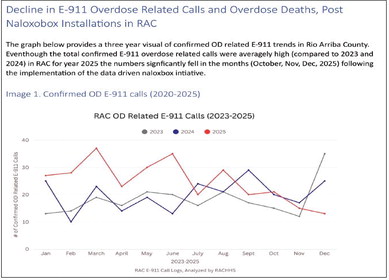
In Rio Arriba County, there’s been a steady increase in the number of overdose-related calls to the Rio Arriba County E-911 Center over the past three years with the highest amount coming in last year.
There were 298 overdose- related calls to the E-911 Center in 2025. There was also an average of 6.5 overdose-related deaths from January to December.
While these numbers may seem high for Rio Arriba County, data shows that toward the end of the year, there was a downward trend in calls and deaths.
By comparison, there were 219 OD-related calls in 2023 and 240 calls in 2024, according to data kept by Rio Arriba County Health and Human Services Director Dr. Ahmed Dadzie. The average num- ber of calls per month from January to December 2023 was 18.25; it was 20 in 2024 and 24.83 in 2025.
However, toward the end of 2025, the number of calls began to decrease. The difference is seen in the October through December averages. The average number of calls was 20.6 in 2023, 20.6 in 2024 and 16.3 in 2025 for those months. What can be attributed to the decrease in OD-related calls to 911? Dadzie thinks it’s the implementation of Rio Arriba County’s naloxbox initiative that launched in October.
“Based on 911 call logs, the total confirmed OD calls in Rio Arriba County prior to the implementation of the naloxbox initiative was around 249 as of Sept. 30,” he said. “The average OD-related calls to E-911 from January 2025 through September 2025 was around 28 every month. After we implemented the naloxbox program, that was starting in October through now, the 28 ODs per month has reduced substantially to 16 per month.”
He said while he cannot say there’s a specific correlation between the drop in numbers and the implementation of the initiative, he can definitely argue that increasing access to Naloxone does have an impact or potentially have an impact on reducing the number of people calling 911 or going to the emergency room.
“It looks like things are going well and if it continues, I think by the end of the year, E-911-related OD calls will definitely be going down,” Dadzie said.
Naloxbox Implementation In early 2025, the county’s Health and Human Services Department conducted a study to learn about what barriers unhoused people face when accessing and using Naloxone for opioid overdoses. The study, which was voluntary, consisted of two focus groups: unhoused people and law enforcement officers. Study participants were recruited from the county’s Re-Route program who were in treatment for substance abuse disorder, according to a prior Rio Grande SUN report.
Naloxone, the generic alternative to Narcan, reverses the effects of an opioid overdose.
“We found that a lot of the unhoused that use substances do not carry Naloxone on them because they think, or deem, Naloxone too bulky cause they have very limited space on them,” Dadzie said in the previous SUN report.
Instead, the unhoused search for the opiate-reversing drug on an as-needed basis, which doesn’t help in an emergency situation because when someone is overdosing, the medication is needed very quickly.
Participants in the study gave feedback on when the Naloxone is needed most and said more efforts were needed to get it into the hands of those who need it either through mobile locations or locations around the area. They also said unhoused people may not call 911 if someone is overdosing because they may be afraid of being arrested.
Dadzie and his team combined what they learned from the study with an analysis of E-911 call center data to determine where ODs are likely to occur in higher- than-average numbers around the county. That led to eight naloxboxes being installed around Española.
Each box has a sign in front of it that says “free Naloxone” with directions on how to administer it to a person who’s ODing.
“We reached out to business owners, we reached out to members of the community to pretty much solicit their buy-in and we were really fortunate to have amazing community partners that were, you know, supportive,” Dadzie said in the previous SUN report.
OD-Related Deaths There also seems to be a downward trend in the number of OD-related deaths. There was a total of 74 in 2023, 55 in 2024 and though there was a total of 79 for 2025, the monthly average from October to December decreased. The monthly average from January to September was 7.4; the average from October to December was four.
“We requested OMI (Office of the Medical Investigator) death records,” Dadzie said. “We analyze OMI death records in relation to OD-related deaths and we found out that prior to the implementation of the RAC naloxbox initiative, the average of OD-related deaths was 7.4 for January through September. Every month about seven people died from ODs. After we implemented the naloxbox initiative, the 7.4 reduced to four per month.”
Dadzie said he and his team are seeing a significant drop in OD-related calls and deaths, which is really promising.
“I’m very hopeful,” he said. “We will continue to monitor the situation and see if the trend continued to the end of the year.”