April 30, 2026


Film Nets 2 Awards
By Chris Patrick Morgan
Special to the SUN
When Executive Producer Diego Lopez speaks of “The Way We Carry Water” — an award winning short film written and directed by Makaio Frazier — he sounds like a proud parent.
“I’ve know Makaio since he was boy and we’ve made some films together before,” Lopez, who heads the Rio Arriba Community Health Council by day, said. “In 2024, he came to ‘Uncle D’ with an idea for a short film — a story based upon his relationship with his grandfather, which I found to be a fascinating idea. I helped him to focus the story and further flesh out the idea, after which he was ready to execute it.”
The film was primarily shot at Los Luceros Historic Site, with additional locations in Estaca and Acequia del Ancon. It stars Drew Lopez as Marcos, a young man who inherits the responsibility of caring for the acequias on the property of his deceased grandfather, played by Marcos Martinez.
“My grandfather and I were really close,” Frazier explains from a farm near Alcalde that he calls home. “I spent a lot of time with him, including helping him work the land. When he died, I took over that responsibility. Grief is nonlinear, and it doesn’t make any sense. The best way I found to process it was through the acequia work. Through that, I came to discover that everything he was teaching me and instilling in me — the love of the land, the need to care for it, the understanding that water is life — was coming to fruition.”
Lopez said the story is universal and is a coming of age story, with a young man who loses his grandfather and has to deal with grief.
“In doing so, he becomes the caretaker of something very personal to him and comes to realize that it’s also much, much bigger than him,” Lopez said.
The 25-minute film takes place over the course of a year and thus required four separate shoots, which is unusual for a film of this length. Production began in October 2024.
“We couldn’t shoot the film linearly, so we did it sequentially starting in October and then shot again in January, March and the first week of June,” Frazier said. “Doing it this way was both a blessing and a curse. It was a blessing because that time in between shoots allowed the story to mature and gave us chances to review what we’d done and come up with new ideas to try. It was a curse because the self doubt would creep in. ‘Like, is this even going to work?’ That, and it was also more costly doing it this way, since we had to set up for four separate shoots.”
On the website Film Freeway, Frazier said, “I wanted to create a film that captures that quiet inheritance with the blend of grief, duty, and belonging that comes when someone leaves you their work as well as their love. By filming across four seasons, I hoped to let the landscape mirror Marcos’ emotional journey: the warmth of summer memories, the starkness of loss in fall and winter, and the fragile hope of spring. My aim wasn’t to make a documentary about acequia culture, but to honor it through fiction and show how tradition is lived in small gestures: a shovel turning soil, water released into a field, a boy learning from an elder. The story is simple, almost wordless at times, because so much of this knowledge and feeling is passed quietly, without explanation.”
Frazier admits that achieving those goals through such sparse film making proved a challenge.
“As an example, the winter scene, which is 6½ minutes, features only one actor,” he said. “It’s just Drew, all alone. How are you going to fill a quarter of your movie with a guy who’s saying nothing? How do you present this simply, and yet keep it engaging to an audience? So we really tried to focus upon the beauty of the bosque, so that people could really experience it. And that silence is necessary in the grieving process. You don’t always know what to say.”
After concluding filming in June of 2025, Frazier found himself in a race against time to finish “The Way We Carry Water” in time to submit for the Santa Fe International Film Festival, which accepted the film and screened it three times last October.
“Santa Fe International is a very competitive festival,” Lopez said. “It’s one of those places which can lead to Oscar nominations and other opportunities. We had three screenings, all of them sold out and the film was well-received.”
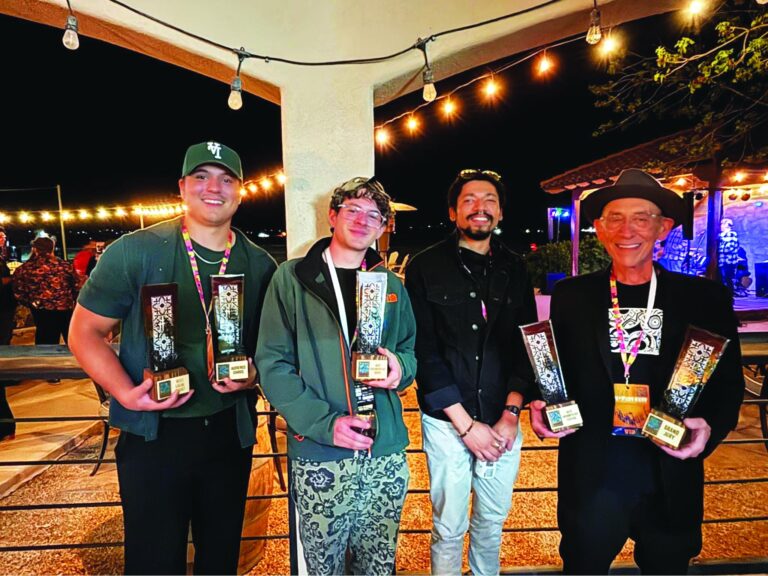
At the recently concluded Las Cruces International Film Festival, “The Way We Carry Water” not only captured the award for Best Local Short, but also the Audience Choice Award.
“I didn’t expect to win anything at all, and I certainly didn’t expect to win Audience Choice,” Frazier said.
Lopez said he suspected they might win the first one, but the Audience Choice was a surprise.
The Las Cruces films proved a banner event for Rio Arriba films. “Setting Hearts Ablaze,” a documentary about Moving Arts Española, won the award for Best Documentary Short, while “American Hate,” directed by Española filmmaker Harry Gantz, won the Best Documentary Feature award as well as the Grand Jury prize.
“It’s good to show that positive things are coming out of Española Valley,” Lopez said. “Because of the area’s reputation, people sometimes dismiss us. But there’s amazing talent here. Some of the best artists in the Southwest come from Española. We were all very proud to represent the region.”
“The Way We Carry Water” followed up its Las Cruces success with three screenings at last weekend’s Taos Film Festival, where it earned recognition as the Spirit of New Mexico Fave award.
“Definitely one of our best audience responses,” Frazier said. “It felt good to bring it home.”
The film also showed last weekend at the Arizona International Film Festival in Tucson.
Three local screenings of “The Way We Carry Water” are slated for later this spring — the first of which will be this Friday at Moving Arts Española, with follow-ups slated for May 9 at Los Luceros and June 5 at Northern New Mexico College.
As for what comes next for the filmmakers, “there’s always a next, and I’m ready for it, because I’ve seen this film 250 times now,” Frazier laughed. Director and producer have new ideas in the works.
“I’ve finished writing a script for a feature film, a psychological thriller set in Chimayó,” Lopez said. “Now comes the part in the process where you try to find the money to make it happen and try to put a production together.”
Upcoming Screenings
Moving Arts Española: 6 p.m. Friday (5/1), 368 Eagle Drive (movingartsespanola.org)
Los Luceros Historic Site: 5 p.m. May 9, 253 County Road 41, Alcalde
Northern New Mexico College: 5 p.m. June 5
For more information about Chile Line Media, visit chilelinemedia.com