April 30, 2026


Commission Opposes Uranium Mining
By Jennifer Garcia
jgarcia@riograndesun.com
Managing Editor
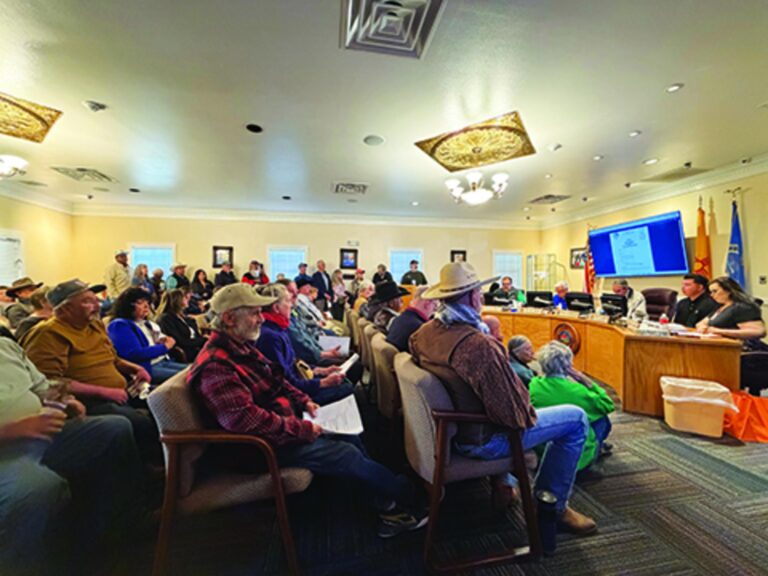
It was standing room only Thursday (4/23) at the Rio Arriba County Commission Chambers in Tierra Amarilla, with people flowing out into the hallway.
Many of those in attendance were interested in one topic on the commission meeting agenda: Uranium mining in the Carson National Forest. Representatives from Rep. Teresa Leger Fernandez’s office, Sen. Martin Heinrich’s office and Sen. Ben Ray Lujan’s office attended and spoke to the audience, letting them know that all three opposed uranium mining operations in the Carson National Forest.
Leger Fernandez, Heinrich and Lujan signed a letter sent to James Duran, Carson National Forest supervisor, on April 9, on behalf of Northern New Mexicans, expressing “serious concerns regarding efforts filed by Gamma Resources Ltd. earlier this year seeking authorization to conduct exploratory uranium drilling within the Carson Nation Forest near Canjilon,” the letter said.
“We strongly oppose approval of this action and urge the Forest Service to require a full Environmental Impact Statement (EIS) before taking any further action on this proposal,” the letter said. “We also request that the Forest Service suspend its review pending congressional action to protect the Chama watershed from mineral development.”
Vancouver-based Gamma Resources Ltd. has proposed drilling up to 12 exploratory boreholes up to 500-feet deep in the Carson National Forest, as part of what the company is calling the “Mesa Arc Project,” according to the letter.
A four-mile stretch of the Chama Basin has been identified as a target for uranium extraction. Gamma Resources Ltd. has expressed its intent to extract the uranium from the area, not just explore it.
“The exploratory phase, if approved, would involve construction of temporary drill pads, approximately 800 feet of new road cuts, and heavy equipment staging — all within one of the most water-sensitive landscapes in New Mexico,” the letter said. “We plan to introduce legislation to withdraw the Chama watershed from all forms of mineral entry. We urge the Forest Service to take that legislative effort into account as it evaluates this proposal.”
District 2 County Commissioner Alex Naranjo said when the commission heard about the proposed digging that Gamma Resources Ltd. wants to do, they worked on a resolution stating that they are “totally and completely against it.”
District 1 County Commissioner Brandon Bustos said the commission is there to be the voice of the people.
“We are going to listen to you,” he said.
County Attorney Adan Trujillo read the resolution, after which Adrian Notsinneh, the president of the Jicarilla Apache Nation, expressed his concern over the proposed drilling.
“We need to protect or tribal land, land grants and our acequias,” he said. “… I’m glad people in Washington are very much as concerned as we are … we need to stand up and prevent this. Water is life. It’s a very important piece that we all rely on.”
He said the message that needs to be carried to Washington is that of a unified voice.
“We’ve been having meetings in Washington with some of our reps on different issues,” Notsinneh said. “This is another topic that can be brought to their ears to say the community doesn’t want this to happen. We’re very much against it. Land, water cattle and farming ties us together.”
Following Notsinneh’s comments, Naranjo said it breaks his heart that the federal government doesn’t listen to local government.
“If they want to go to Iraq or Iran, that’s their prerogative, but we don’t want them here in New Mexico,” he said.
District 3 Commissioner Moises Morales said “we need a lot of help in Washington to correct these injustices.”
Members of the public were given the opportunity to speak out on the proposed mining, but because of what County Manager Jeremy Maestas said was a “technical issue,” the majority of public comment could not be heard by those viewing the meeting via Zoom.
Ghost Ranch Chief Executive Officer David Evans, who attended in-person, said faith and democracy has been tested this year, but the meeting reignited his faith in democracy.
“We’re your neighbors, we use the same water and the same air,” he said “… We’re here to help and do everything we can to beat this.”
Both candidates for the state representative in House District 41 seat issued statements opposing the uranium mining. Debbie Rodella, who was a member of the New Mexico House of Representatives from 1993 to 2018, when she was defeated for renomination in the Democratic Party by current Rep. Susan Herrera, D-Rio Arriba, Santa Fe and Taos counties, wrote that it’s critically important to protect Northern New Mexico’s natural resources and cultural heritage, noting that water remains central to the region’s way of life.
“Water is the lifeblood of northern New Mexico,” she wrote. “Our acequias, our land, and our traditions have been protected and honored for generations. Any project that could put those at risk must be approached with extreme caution and full transparency.”
She also said communities like Canjilon deserve to be fully informed and involved in any process that could impact their future.
Rodella’s opponent, Yolanda Jaramillo attended the Thursday meeting but also issued a written statement in which she said uranium mining has already left a devastating legacy which has resulted in serious health impacts on communities, contaminated water and damaged land.
“Generations of miners and downstreamers have suffered long-term exposure, leading to high rates of cancer and other illnesses,” she wrote.
There are hundreds of abandoned uranium sites across the state and the cleanup will cost hundreds of millions of dollars, the statement said.
“We must learn from our history,” it said. “Until we clean up existing contamination, we should not allow new uranium development.”